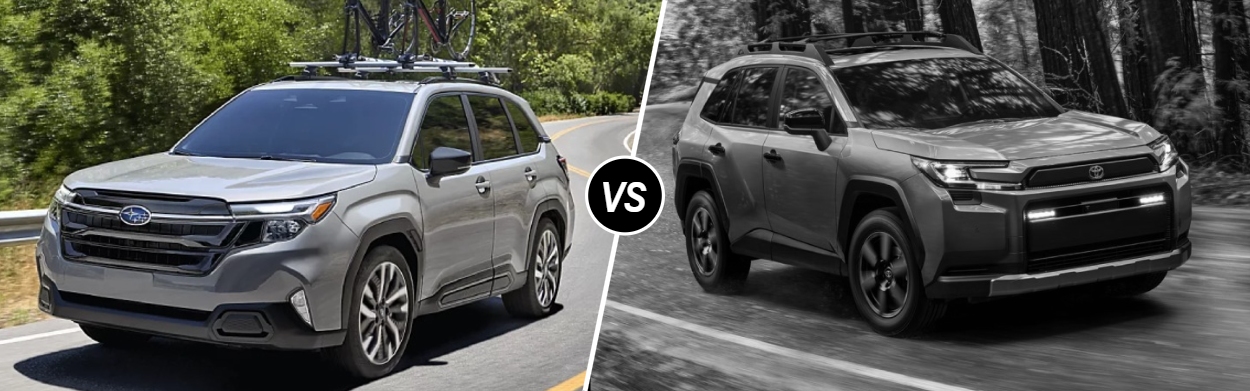
If you’re weighing 2026 Subaru Forester vs 2026 Toyota RAV4 for daily life in Boulder, CO, both compact SUVs bring modern tech, confident safety, and useful utility. But their core philosophies differ. Subaru builds the Forester around standard Symmetrical All-Wheel Drive for surefooted traction on everything from Canyon Boulevard to peak-hour I-36 merges, while Toyota leans into hybrid efficiency and a wider spread of front- or all-wheel-drive options. The Forester’s spacious cabin, up to 74.4 cu ft of cargo room, and available Dual-function X-MODE make it an easy fit for weekend routes to trailheads above Nederland and quick grocery swings along 28th Street. Toyota counters with a standard 12.3-in. digital cluster and available 12.9-in. multimedia display plus its Toyota Safety Sense 4.0. As your local partner at Flatirons Subaru, we know what works across the foothills, on damp mornings near Chautauqua Park, and on those winding drives toward Eldora. The Forester’s traction-first engineering and thoughtful packaging are the reasons our team recommends it—especially when surfaces, elevation, and plans change by the hour in Boulder, CO.
| Feature | 2026 Forester | 2026 RAV4 |
|---|---|---|
| Standard all-wheel drive across entire lineup | Yes | No |
| Dual-function X-MODE with Snow/Dirt and Deep Snow/Mud | Yes | No |
| EyeSight Driver Assist Technology standard | Yes | No |
| 360-degree Surround View Monitor available | Yes | Yes |
| DriverFocus Distraction Mitigation System available | Yes | No |
| Maximum cargo volume of 74 cu ft or more | Yes | No |
| Passenger volume above 110 cu ft available | Yes | No |
| Panoramic power moonroof available | Yes | Yes |
| Power liftgate available | Yes | Yes |
| 3,500-lb tow rating available | Yes | Yes |
The Forester’s design balances rugged and refined—clean contours, a confident grille, and functional elements like standard LED Steering Responsive Headlights and available LED fog lights. Roof rails are standard or available across trims, so mounting bikes or a cargo box is simple for quick getaways to Erie and Lafayette. A panoramic power moonroof (standard on most trims) lets in light on bluebird afternoons, and the extra-wide rear gate opening makes it easier to load bulky items without contorting your cargo. For drivers who favor factory-built adventure capability, the Forester Wilderness brings a raised suspension with 9.3 inches of ground clearance, matte black 17-inch wheels with Yokohama GEOLANDAR all-terrain tires, and protective cladding—all engineered to shrug off ruts and washboard surfaces that are common on county roads west of town. Toyota’s 2026 RAV4 also taps into an adventurous aesthetic with available all-terrain tires on Woodland and a bold exterior profile, plus a panoramic glass roof on higher trims. Where Forester shines is how those rugged cues translate into confidence underfoot, whether you’re taking a rougher shortcut to the trailhead or maneuvering into a tight space near Pearl Street.

Step inside and the Forester immediately feels open and welcoming, with an airy greenhouse and excellent sightlines for tight parallel spots downtown and angled trailhead parking. Depending on trim, you can equip a high-resolution 11.6-inch Subaru Multimedia touchscreen with wireless Apple CarPlay and Android Auto, plus a wireless device charger to keep phones topped up without cords. The available hands-free Power Rear Gate makes quick work of gear when your hands are full after a grocery run along Arapahoe Avenue. Forester’s strength is practical space: up to 110.8 cubic feet of passenger volume is available and maximum cargo volume reaches 74.4 cubic feet—more than RAV4—so bikes, coolers, and a weekend’s worth of camping bins go in without drama. Comfortable materials scale from durable cloth to leather-trimmed upholstery with Dinamica inserts on Touring, while heated front seats, a heated steering wheel, and even heated rear outboard seats (Touring) are available for cold mornings. Toyota answers with a tech-forward cabin, including a standard 12.3-in. digital gauge cluster and available 12.9-in. multimedia screen. Still, when it comes to everyday usability, Forester’s straightforward controls, broad outward visibility, and generous storage solutions stand out in Boulder, CO traffic and on gravel pullouts alike.

Subaru’s mechanical approach is foundational: Symmetrical All-Wheel Drive is standard on every Forester, so you never have to think about whether you chose the “right” drivetrain for changing conditions around Boulder, CO. The low, balanced layout supports stable handling on curvy climbs toward Flagstaff Road and composed braking when you’re descending with a full load. Forester’s X-MODE integrates seamlessly with its AWD system for enhanced grip, and Dual-function X-MODE (Sport, Limited, Touring, Wilderness) adds Snow/Dirt and Deep Snow/Mud settings for more tailored traction on loose surfaces. Trailer Stability Assist, Vehicle Dynamics Control, and Active Torque Vectoring are standard, supporting calm responses when crosswinds pick up on CO-93 or you navigate uneven shoulders on rural byways. Toyota’s 2026 RAV4 offers multiple drivetrains—FWD for efficiency and available AWD for added grip. Its Multi-Terrain Select and available Trail-oriented features are robust, especially in Woodland or Adventure-style trims. Still, Subaru’s uniform AWD strategy and the way X-MODE collaborates with its chassis create a confidence that’s easy to feel in the first few blocks, and even more so when the pavement gives way to dust, gravel, or a steep driveway with fresh landscaping pebbles.

Forester’s 2.5-liter SUBARU BOXER 4-cylinder makes 180 hp and 178 lb-ft of torque and pairs with a Lineartronic CVT. The horizontally opposed BOXER layout contributes to a low center of gravity, enhancing balance on quick transitions through downtown roundabouts or while threading traffic near the University district. Subaru Intelligent Drive (SI-DRIVE) lets you tailor response for relaxed cruising or snappier pedal feel, and the transmission offers 8-speed manual mode on most trims for a more connected drive. Towing is confident and straightforward, with up to 3,500 pounds available on the Wilderness trim—plenty for a small camper or a compact utility trailer for yard projects. Toyota takes a different path with the 2026 RAV4 lineup, emphasizing hybrid performance. It offers strong efficiency estimates and available AWD, plus robust towing capability up to 3,500 pounds depending on configuration. While Toyota’s hybrid architecture is a draw for efficiency-first shoppers, the Forester’s powertrain is engineered for consistency: no matter which trim you choose, you get standard AWD, intuitive response, and the inherently balanced dynamics that make the vehicle feel settled and predictable on everything from foothill curves to tight parking ramps.
Subaru prioritizes safety throughout the Forester lineup with standard EyeSight Driver Assist Technology, providing core functions like Pre-Collision Braking and Advanced Adaptive Cruise Control. Available Automatic Emergency Steering supports avoidance maneuvers when space permits, and on Touring you can add a 360-degree Surround View Monitor for a top-down perspective in close quarters. Blind-Spot Detection with Rear Cross-Traffic Alert is standard or available depending on trim, and Reverse Automatic Braking is available or standard on upper trims for added confidence in busy parking lots. The available DriverFocus Distraction Mitigation System on Touring brings an extra set of attentive eyes to help recognize potential distraction or drowsiness. Subaru’s safety credibility is reinforced by a 5-Star Overall Vehicle Score from NHTSA and strong owner satisfaction ratings. Toyota equips the 2026 RAV4 with Toyota Safety Sense 4.0, including features like a standard 12.3-in. digital cluster that helps keep key info centered in view, and available systems such as Advanced Park and Traffic Jam Assist for controlled-access highways. Both crossovers deliver modern protection; the difference is how thoroughly Forester bakes its safety suite into every trim and how well it integrates visibility, chassis balance, and braking to deliver calm, predictable responses when it counts.
Our team at Flatirons Subaru recommends Forester for drivers who want consistent traction, easy-to-use tech, and real everyday versatility that fits Colorado’s mix of city streets and mountain-adjacent routes.
When shoppers ask us to compare 2026 Subaru Forester vs 2026 Toyota RAV4, we acknowledge what Toyota does well—an advanced safety suite, available park-assist features, and a tech-rich interface. But for how people actually drive here, the Forester’s strengths are hard to beat. You get standard Symmetrical All-Wheel Drive on every trim, an available traction toolkit with Dual-function X-MODE, generous space that simplifies family life and weekend projects, and visibility that lowers stress in crowded lots and on narrow canyon roads. Those qualities, combined with the Forester’s 8.7 inches of ground clearance (9.3 on Wilderness) and available 3,500-pound tow rating, create a crossover that simply feels sorted for Boulder, CO. At Flatirons Subaru, we’ve helped countless drivers prioritize confidence, space, and ease of ownership—qualities that shine brightest in the 2026 Subaru Forester. If you’re choosing between these two nameplates, our advice is to test their traction and packaging back-to-back on the same loop; most shoppers can feel the difference within a few blocks.